


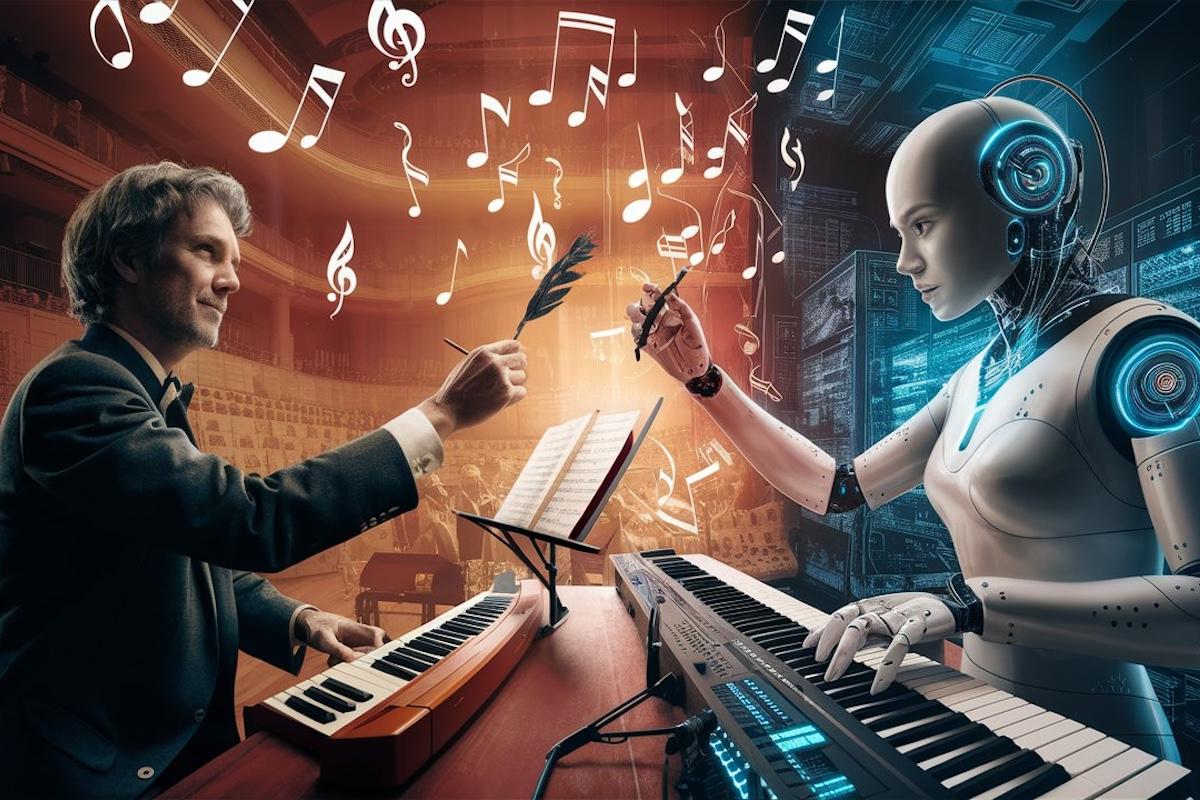
Think of the last song you heard on your favorite streaming service. Was it performed by humans – or AI? It’s getting hard to tell. Maybe you haven’t noticed it, but AI has started to be incorporated into the music that we all listen to and enjoy.
Could this be part of a larger pattern in how humans generate music? In the last 100 years, the way we play and listen to music has changed countless times, from the gramophone to the record player to cassettes to CD players to the eventual invention of streaming services like Spotify or Apple Music.
Even with all these new inventions changing the way music is produced, one thing has always stayed the same: its integrity. Music has always been an intimate form of self-expression that allows artists to creatively convey common elements of the human experience.
But does AI take away that integrity?
This is where one of the largest misconceptions about AI music lies. People commonly assume that if you give Suno or Claude a prompt, it will instantly generate a full-fledged, engaging song.
We at the Roar put this premise to the test and asked ChatGPT to generate a contemporary folk ballad. Instead of inventing an actual song, though, ChatGPT just took the broadest possible generalization of the genre we requested and slapped some off-key singing on top.
Musician Sonny Mulnick ‘26 had a similar experience. “Using AI for songwriting takes the artistry out of it,” he said.
This is when we realized that AI has a very similar effect on music as it does on writing. If you ask ChatGPT or Claude to generate an entire essay or paragraph, it will most likely create something robotic and monotonous. If you give AI a single sentence and ask it to reword it or make it clearer, however, it will have no trouble producing a more understandable sentence.
The same is true with music; AI might be beneficial in creating a framework or certain lyrics, but it seems to struggle with generating an entire song that carries substance.
Many musicians at Milken have similarly discovered these limitations of AI.
“I think that AI, as it stands today, has the potential to be helpful when it comes to the grunt work of writing music, like maybe creating sheet music,” Said Ms. Martone, a Milken performing arts teacher.
AI can also have a successful impact on other aspects of songwriting.
“There are often a lot of things that need to be done in the process of recording that can take a while, ” said Elan Schwimmer ‘28. “And AI has the potential to make those take less time.”
Some believe AI could serve as a good organizational tool.
“Just like kids who use AI for homework just to get their work done, I think that people who use it (AI) for writing music want better organization than they can think of, and they want it to create ideas for them,” said Sonny.
For some students and teachers, the jury’s still out.
“I think it could be a useful tool, said Ms. Martone. “However, I’ve yet to see it function well enough yet to be a tool.”
Although these concerns grow even more prominent in musicians’ minds, especially with technology’s day-by-day advancements, there was an overwhelmingly optimistic view on what the future of music holds with AI in the picture.
“The act of playing an instrument and playing live music for other people will never be overshadowed and will be enjoyed by musicians forever,” said Nava Herstein ‘26.