


While schools across the country introduce policies to limit cell phone usage on campus, students continue to find ways around them, leaving classrooms filled with ring tones, notifications, social media, and, worst of all, divided attention.
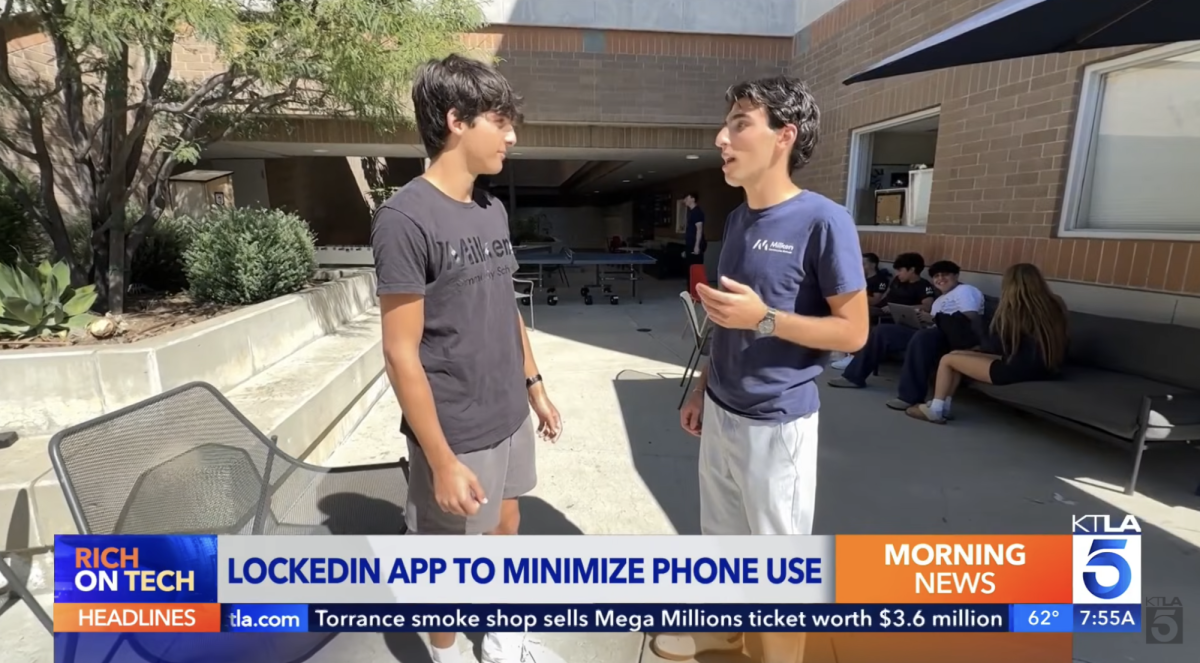
Milken students Noah Fakheri ‘26 and Brian Ohebshalom ‘26 have come up with a solution: LockedIn, an app designed to eliminate phone distractions during the school day without relying on constant enforcement.
The idea for LockedIn came after its founders noticed how ineffective traditional policies had become in practice.
“We saw Milken implement phone policy after phone policy, but through each one, students would still use their phones,” Brian said. “Standing next to their friends, students would have their faces buried in TikTok and Instagram.”
Rather than continuing to rely on rules that students could ignore or bypass, the creators of LockedIn wanted to build a system that removed the temptation altogether.
At its core, the app functions automatically throughout the school day. When students arrive on campus, their phones shift into a restricted mode that blocks distracting apps while still allowing access to essential tools.
“LockedIn is an app that schools use to manage phone use during the school day,” Noah said. “When a student arrives on campus, their phone automatically locks into a school-approved mode… When they leave campus, their phone returns to normal.”
This automatic transition is what sets LockedIn apart from existing solutions like screen time limits or simply asking students to put their phones away. According to its creators, those approaches still depend on individual choice, which can be difficult to maintain in an environment where phone use is constant.
“Putting your phone away still leaves the temptation there, and screen time can easily be bypassed or ignored,” Brian said. “LockedIn is different because it removes the decision entirely during school hours.”
The founders also point to a larger issue underlying phone use in schools: addiction. They argue that current policies often fail because they treat phone use as a simple behavioral issue rather than a deeper habit.
“People are so addicted to their phones that they drown everything else out,” Brian said. “Current policies ask the students to put their phones down, similar to asking a person addicted to substances to put their substances away.”
While the concept may seem straightforward, building and implementing LockedIn came with unexpected challenges. Beyond developing the technology itself, the team had to navigate the complexities of working with schools and administrators.
“One of the biggest challenges was realizing that building the technology was only part of the job,” Noah said. “Schools move slowly, and every decision involves so many different people.”
Despite these obstacles, early student feedback has been largely positive. Although some students initially resisted the idea, many reported that the app ultimately improved their daily experience at school.
“At first, a lot of students assume they won’t like it, but once they experience it, many say it actually makes school less stressful because they’re not constantly distracted,” Brian said.
Students have described feeling more present not only in class, but also during social time throughout the day, suggesting that reducing phone use may have broader benefits beyond academics.
“It’s not about taking phones away, it’s about creating a break from them,” Brian said.
As schools continue to search for effective ways to address phone use, LockedIn represents a shift away from enforcement-based policies toward systems that reshape the environment itself. By removing the constant pull of notifications and social media, the app aims to create a more focused and connected school experience, one where students can fully engage without the distraction of their screens.
With the founders already in discussions with several area schools, including Milken, and growing interest highlighted by local media coverage, LockedIn is beginning to gain real momentum. If adopted more widely, it could signal a new approach to how schools balance technology and attention in the classroom.