


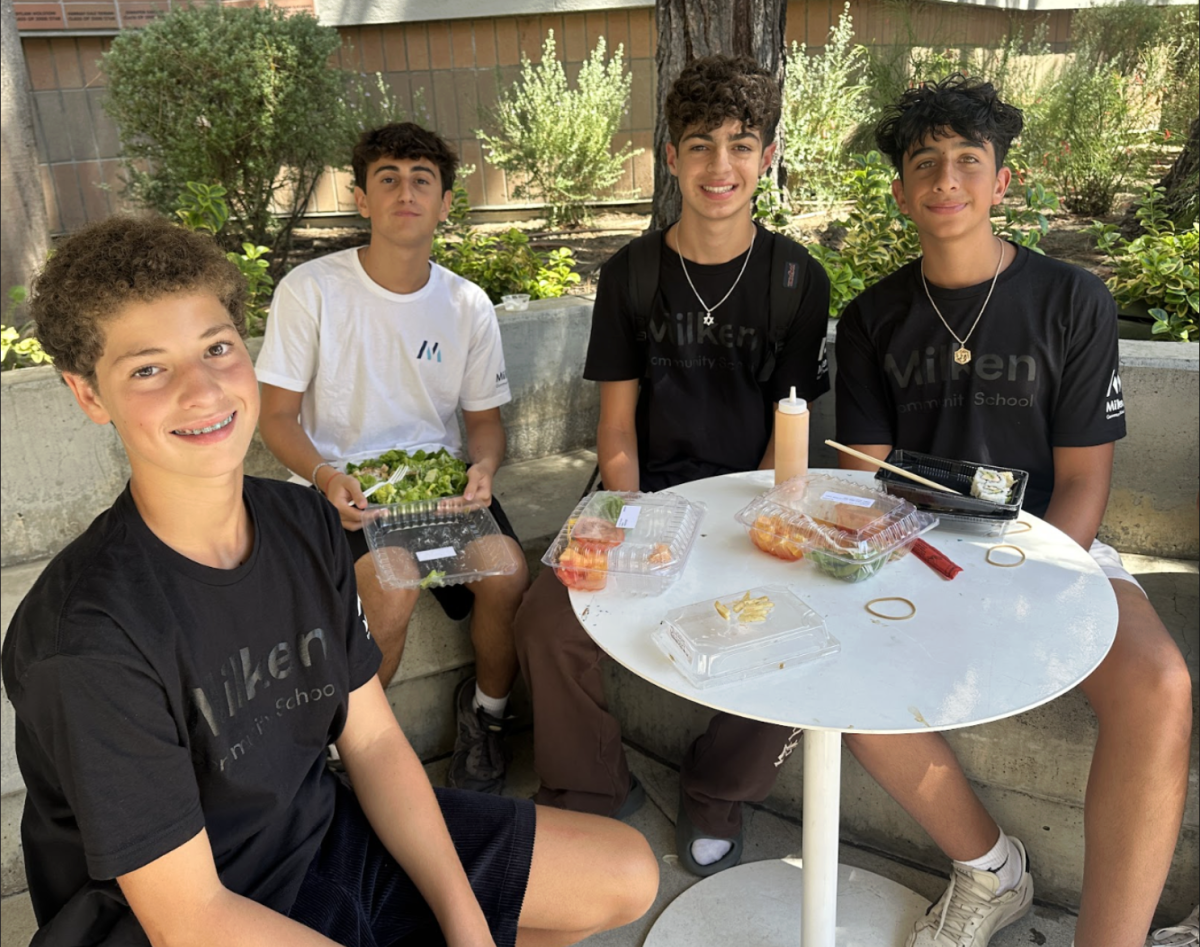
Sirens, fires, and rising antisemitism have reshaped where students go to school this year. Due to the ongoing war in Israel and the Palisades fire, many families in our area began looking for safer, more stable school environments that reflect Jewish values. As a result, this year, Milken Community School has its second largest ninth-grade class ever with 156 students.
“Milken was never in the picture. I was supposed to go to Pali, but I really do like Milken,” said Mason Michael ‘29
Ari Farahmand ’29 made the transition from Paul Revere Middle School.
“Even though Milken wasn’t my plan, I’ve loved my start in 9th grade, meeting new people and being in classes that are way different,” he said.
This explosive growth has created a new social dynamic for those who attended Milken’s middle school. While many students enjoy the expanded social circle, others noted the adjustment. One student described the change as “fun but overwhelming at times.”
“It’s noticeable how big our grade has gotten, especially from middle school,” said Eli Nassibi ‘29.
According to Riley Gozarkhah ‘29, “environmental issues were a clear factor in the enrollment boost.”
“I think the Pali fires definitely made an impact on our grade, but Milken is such a great school,” she said.
Despite the challenges of a larger student body, faculty members expressed optimism. Ms. Monica Daranyi, the 9/10 Dean, has spent 30 years working at Milken. She believes the expansion reflects the school’s growing reach.
“To watch it grow this much is exciting,” Ms. Daranyi said. “We get kids all over LA now.”
Though some classrooms are a little more crowded than in years past, the students and teachers have adjusted.
“Some students I’ve talked to have said they like having more students in their classes. Seeing more friendly faces is fun and we should embrace it before we move to Milken East. Everyone has said it’s a huge campus!” said 9-10 Division Head Mr. Scarlata.
“The growth is felt in the seating charts,” said Ms. Caroline Doherty, a second-year Spanish teacher.
“It took a long time to get used to the routines,” she said. “After a while, we got into a nice balance, and not a higher amount of infractions or official notes have had to be given out in this class either.”
Ms. Doherty also noted that the larger groups require a stricter adherence to seating and a slightly slower pace to ensure no student is left behind.
“I really enjoy the class and I like how it is a bigger class with lots of students to hear from,” said Jessica Broukim ‘29.
Have the extra numbers dampened the spirits of the Class of 2029? Quite the opposite, according to Ms. Doherty. She described her current 9th-grade Spanish classes as some of her best-behaved and most energetic students.
For teachers like her and the Class of ‘29, the challenge of bigger class sizes has been met with the reward of unique, high-energy classroom dynamics.