


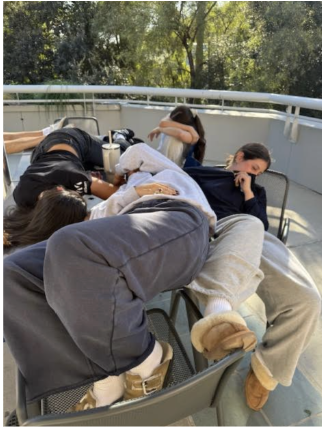
You are walking in the hallway, and you hear a student say to her friend, “Oh my goodness. I am so tired.”
You turn the corner and you hear it again from someone else: “Wow, I’m tired.”
Milken students have repeatedly expressed their ongoing fatigue to anyone who will listen. It’s enough to make one wonder:
Why is everyone so tired? Do we stay up too late? Does Milken start too early? How can we change things for the better?
Now that the second semester is well underway, many students are concerned about their low levels of energy and alertness, especially first thing in the morning.
There is more than one reason for this.
“I kind of just sit on my phone.” said Dylan Ebrahimi, 28’, explaining why he goes to sleep so late.
This habit, known as doom scrolling, is an issue that many other students seem to empathize with. To make phones less distracting, one teacher recommended that students keep them outside of the room in which they work or sleep.
Additionally, many students find it difficult to balance all the demands on their time; there just don’t seem to be enough hours in the day for athletics, school work, and a healthy amount of rest.
“I love soccer, but I get home late every night and have to do all of my homework and I feel like my eyes are closing,” said Lexxi Arinos Schricker ‘28. “I honestly feel like I am drained physically and mentally.”
Penny Pearlman 29’ agrees.
“I have barely any time to do my work and sleep with such a busy sports schedule,” she said.
Milken sports require a very large time commitment, but participation is still encouraged. With the strict attendance policies and large amount of homework, this is another cause of tiredness: when students sacrifice sleep to focus on their passion for athletics.
What’s too often overlooked is the fact that sleep is perhaps the most important activity on a student’s schedule. Without enough of it, it’s impossible to do your best in the classroom or playing field.
According to Ms. Jeannine Hiebert, the school nurse, it is possible to balance extracurriculars and sleep if you use the right tools.
For example, she recommended that students remember, “Your bed is not your workplace, it is just for sleeping.” This is a tool she encouraged the entire community to utilize.
Nurse Hiebert also pointed out that Milken students tend to be very achievement oriented – an admirable trait, but one that comes with certain trade-offs.
Furthermore, not only student athletes struggle with sleep. All Milken students have loads and loads of work, and still have to wake up at around 6:30 in the morning.
“I think that students at this school are the most educated and prepared for college compared to any other school I have worked at,” said Nurse Hiebert. “But it also comes with the biggest workload I have seen.”
Lily Shotz 28’, agrees. “I truly do not get enough rest because I have three to four hours of homework every night and I still have to eat dinner and get ready for bed.”
Shotz expressed that it can be challenging to find the time for self care.
“No one understands how long it takes to get ready for bed, even though it sounds like it should not take that long,” she said.
One possible solution? Move the school’s start time from 8:00 to 8:30. According to a Penn State University educational article, just one hour more of sleep per night has significant health benefits on college students. An extra hour would also undoubtedly help growing and determined high school students loaded with many extracurriculars.
Public high schools in the area are already taking steps in this direction. In 2022, California mandated later school start times. It’s now against the law for high schools to start earlier than 8:30 a.m. in California public schools. Middle schools may not start earlier than 8:00 in the morning. LAUSD schools have adjusted to meet this requirement. Milken, however, is not required to start late because it is a private school, therefore not under this umbrella.
Furthermore, Milken’s location on Mulholland Drive is designated as a special “corridor,” so it is impossible to start any later due to the traffic caused by other schools on the stretch.
That said, Milken has implemented many free blocks and tools, such as Flex Block and Lishma, in order to allow students to get more work done during school hours.
Moreover, students must play their part as well and be able to recognize the appropriate time to put down their devices and go to sleep. Since it is impossible to build 30 extra minutes into the day via the school schedule, people must utilize the time to the best of their abilities to create their own extra time, whether that means disconnecting from the phone, studying in a separate area, or finishing more work during free time.