

When the first Prime Minister of Israel David Ben-Gurion began laying the foundations of the country, he faced the challenge of uniting and appeasing a surprisingly diverse population, despite the nation’s definition as a “Jewish state.” United by a desire for freedom and security, Jews from around the world and across religious sects began returning to Israel. Even before the major waves of Zionist immigration, one such population was the Old Yishuv, a small community of devout ultra-Orthodox Torah scholars who began returning to the land during the late 1800s and early 1900s.
At the time, Ben-Gurion agreed to exempt this small and seemingly insignificant population from military service, allowing them to focus on Torah study as a means of integrating them into the new state.
That small compromise had far-reaching consequences. Ben-Gurion did not anticipate that the Old Yishuv population would grow to roughly 1.3-1.4 million “Haredim” (the Hebrew term for Ultra-Orthodox Jews) today. This demographic explosion transformed what was meant to be a temporary solution into one of Israel’s most contentious political issues nearly eighty years later.
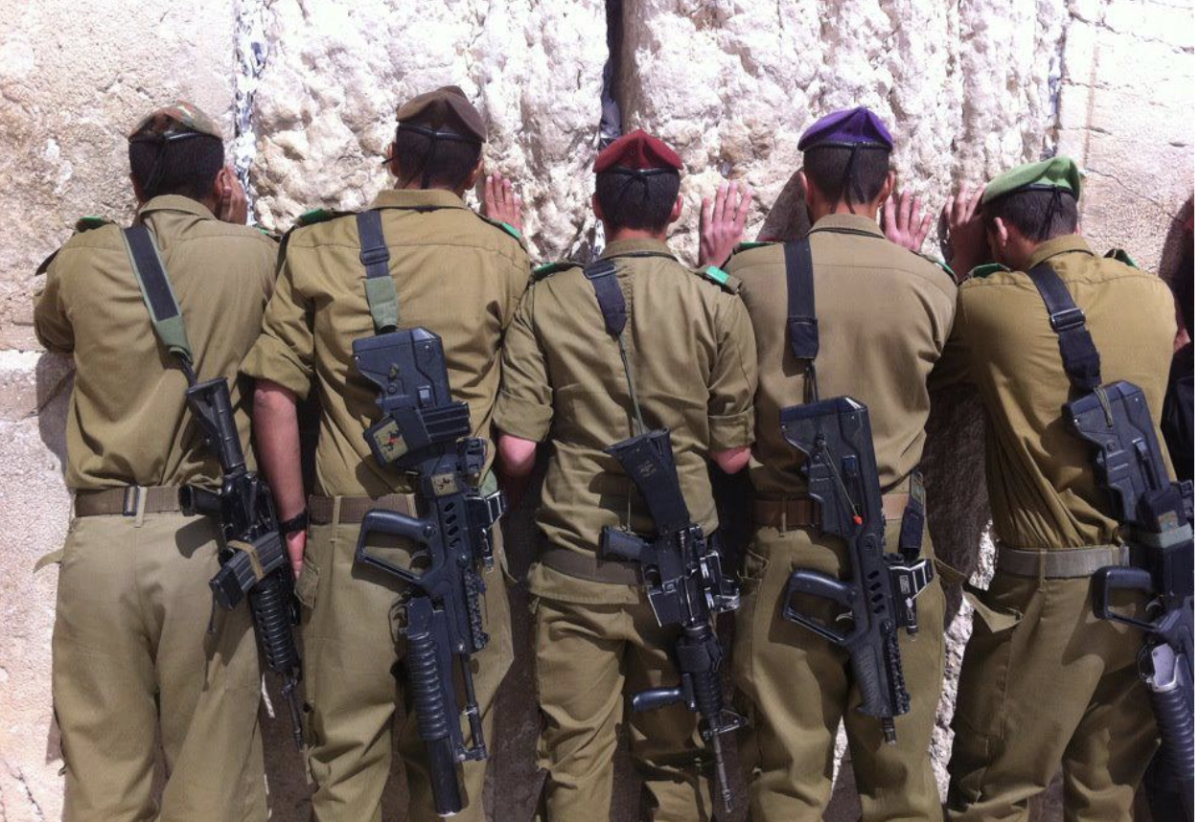
Today, Haredi protests often grip areas surrounding Jerusalem with protestors shouting slogans such as “We’ll die before we enlist.” Thousands of Haredi men have ignored or refused orders to enlist even as the nation has been at war since the October 7, 2023 massacre. They are often concerned that if they join a military surrounded by more secular Jews, they will lose their strictly religious way of life. Many Haredi political and communal leaders maintain that their intensive Torah study constitutes a form of national service, providing spiritual protection to Israel comparable to military service.
Meanwhile, tens of thousands of reservists (mostly young and middle-aged men who had already completed their service) left their families, businesses, and communities to rejoin the ranks. Many of them serve in roles that otherwise would be filled by the Haredi men exempt from military service. According to statements from the IDF, there is currently a manpower shortage of 8,000-12,000 soldiers.
As the war dragged on, tensions between Haredi and secular Israeli communities intensified. The sense of unity that once defined all Israelis despite their religious practices has slowly eroded.
From a political standpoint, the current coalition under Benjamin Netanyahu has further complicated the issue. Netanyahu’s government has survived with a narrow majority in the 120-seat Knesset (Israeli parliament), making it highly sensitive to shifts in party support. Ultra-Orthodox parties such as United Torah Judaism (UTJ) and Shas are key to maintaining Netanyahu’s coalition. However, they have threatened to leave his government or have already left over disputes about Haredi conscription.
As a result, any long-term effort to mandate Haredi military service would place Netanyahu’s political survival at serious risk.
Although the pace of the war has slowed, tensions surrounding this issue remain unresolved. Despite this, many Israelis, secular and religious alike, may not recognize that given the current political reality, neither fully forcing Haredi conscription into normal ranks nor granting full exemption is realistically achievable.
One potential solution lies in expanding Haredi-specific units within the IDF. As stated above, many Ultra-Orthodox Israelis fear that military service would force them to compromise their strict religious practices. However, the IDF has already established combat and support units designed to accommodate Haredi religious needs. While these units may not assume the same operational roles as standard combat brigades, their expansion could nonetheless significantly ease Israel’s ongoing manpower shortage. This would also allow Haredim to support national defense without abandoning their religious commitments.
However, implementing this solution may prove challenging, as many Haredi education systems do not prioritize instruction in English, math, and science, all of which are critical skillsets in many IDF roles.
Additionally, while the conflict of the past two years has deepened the controversy surrounding Haredi conscription, it has also created opportunities to explore other potential solutions. One may be through the program of Sherut Leumi, which is national/community service in Israel. Thousands of communities and families across Israel have been torn apart by the war and require support that they may not have access to.
To contribute meaningfully to the country that protects them, Haredi communities could, at the very least, participate in community service roles. These paths of service would accommodate the intense religious practice of Haredi communities, while still requiring them to complete meaningful work in Israel. By working to serve both religious and non-religious communities alike, this would hopefully unite secular and ultra religious Israelis.
Whether either of these paths is politically feasible or will gain support from influential Israeli leaders remains uncertain. One thing is clear: under the current government, they are unlikely to even be considered.
Nevertheless, it cannot be emphasized enough that, to heal these deep divisions in Israeli society, a compromise must be reached: one that respects both sides while requiring concessions from each. Political division and a prolonged refusal to compromise contributed to Israel’s vulnerabilities exposed on October 7th. Failing to reach any agreement while trying to politically “defeat the other side”, risks repeating the very mistakes that left Israel weak in the first place.