



Artificial Intelligence is changing the way people live, work, and learn, and Milken doesn’t want to be left behind.
On August 18th, before the start of the fall semester, teachers gathered for a workshop on AI led by Mr. Eric Hudson, an educational consultant who specializes in artificial intelligence and program design. Organized by Ms. Carter, Director of Educational Technology, the training introduced Milken’s faculty to the tools, challenges, and possibilities that AI brings to education.
Given how fast AI has grown in recent years, Milken’s decision to train teachers early shows a commitment to staying ahead of the curve.
“I know it’s here. There’s no point in resisting it,” Head of School Dr. Shulkind explained. “It’s not good or bad. It’s just, what are you going to do with it? As educators, our energy should be on using AI as a powerful tool, not policing it.”
Milken first began planning for AI integration after Shulkind attended an NAIS conference where Hudson spoke about the importance of approaching AI in human-centered ways.
“The idea was to start with the adults,” Shulkind said. “Students are often so far ahead of adults in technology, and that can feel unnerving. We wanted to give teachers the tools so they could experiment and see the benefits of AI themselves.”
After attending the workshop, AP Microeconomics teacher Mr. Miller reflected, “[The workshop] helped introduce me to some new AI tools. It honestly was nice to have the pervasive issue of AI addressed and be introduced to some new platforms. Eric’s ideas were very clear: AI is inevitable and it’s up to us to work with it rather than against it.”
Ms. Carter played a central role in bringing the training to life. She also launched a faculty book study of Co-Intelligence: Living and Working with AI by Ethan Mollick. After giving Milken teachers some time to read the book, Ms. Carter organized a lunchtime meeting in mid-September to give faculty the opportunity to reflect with each other and discuss ideas from the chapters they felt were most insightful.
Acknowledging AI and its role in society, Ms. Carter knew she needed to play an instrumental role with Milken’s integration of AI despite the fact that few other high schools are doing the same.
“Less than 20 percent of the nation’s teachers reported their school had a formal A.I. policy,” she noted, referring to a New York Times article she read and a major reason why she organized the lunchtime meeting with Milken staff.
AI is already showing up in classrooms, enhancing students’ learning and helping teachers propel into the future.
Mr. Lindsay, Head of the 11/12 Division and U.S. History teacher, described an activity where students used AI to create political cartoons. Instead of merely studying existing cartoons, students brainstormed issues, symbols, and satire, and then used AI to bring their ideas to life.
“They’re doing the thinking,” Lindsay explained. “What is the issue they want to satirize? What are the symbols they want to use? Then AI helps create a unique cartoon from that.” Other departments are experimenting with AI as well.
When asked about his use of AI inside the classroom, Mr. Miller remarked, “It’s like talking to a teacher if I need help on something. I’ll often ask ChatGPT: ‘Am I explaining this concept correctly?’ or ‘What part of my explanation needs to be clearer?’ That’s been the biggest benefit of AI for me.”
Additionally, AP Physics teacher, Mr. Gallway, noted, “AI has allowed me to develop a more varied and dynamic curriculum by helping me design lessons that incorporate multiple modalities and encourage student-driven exploration. It also supports student learning by providing real-time, individualized feedback, helping them engage more deeply with the material and make meaningful progress at their own pace.”
Despite the speculation that AI has already negatively impacted learning, some Milken students are already finding their own ways to efficiently use AI for research. Ms. Carter recalled a moment when a student used Perplexity, a free AI-powered answer engine that provides accurate, trusted, and real-time answers to any question – to find quick, detailed information for a class discussion. Instead of spending time on scattered Google searches, the student was able to dive right into analysis.
Dr. Shulkind had a similar realization at home when her daughter used AI to instantly locate a quote in To Kill a Mockingbird.
“What previously used to be inefficient is now efficient because of AI,” she said. “Seeing that moment made me realize we really need to shift our mindset and think about how AI can help us learn more effectively.”
Like any new technology, AI comes with both opportunities and challenges. Teachers see it as a way to make learning more engaging, efficient, and creative. At the same time, there are concerns about plagiarism, over-reliance, and the fear that AI might replace human creativity.
“When technology evolves and changes society, it’s first critiqued for what it takes away from us,” said Mr. Lindsay. “But we need to push through that and look at how it helps us, by making things more efficient, by opening up new opportunities.”
Additionally, Mr. Miller noted, “AI allows for students to reach a higher ceiling but also fall to a lower floor. Students can use AI to get to places they’ve never been before but it also leaves room for students to get even less out of their education experience than before.”
Ms. Carter agrees, adding that the biggest responsibility lies with educators.
“If the work we give students feels like busywork, they’ll use AI every time,” she said. “But if the work is meaningful, relevant, and engaging, students want to do it themselves. That’s when AI becomes a tool instead of a shortcut.”Many students agree that AI can in fact be a helpful tool.
David Azran ‘28 noted, “I use Quizlet AI for flashcards and study guides in history, and ChatGPT to answer questions I don’t know. Although some students use it to skip learning, it’s also a great tool when teachers aren’t available to help.”
Another student, Cricket Abouaf ‘28, stated, “I mostly use Grammarly and ChatGPT to organize essays, create study guides, or double-check information. While AI makes learning easier, it’s also made students less motivated to think for themselves. I think it helps with structuring work, but could harm creativity and future jobs.
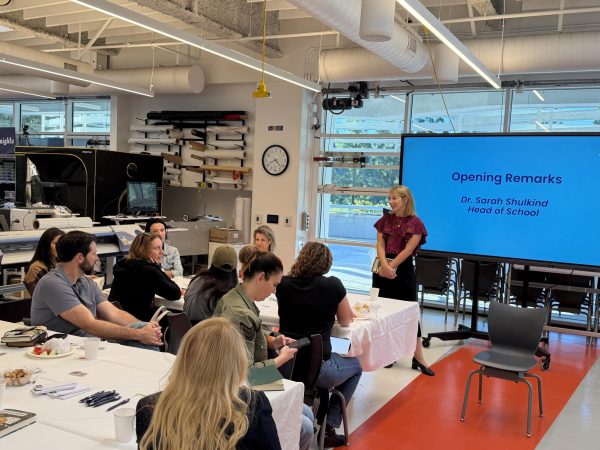
Milken’s long-term goal is not just to keep up with AI, but to show how schools can use it responsibly. Ms. Carter has already outlined a three-year plan that includes regular teacher workshops, student training, and even parent education about AI’s role in learning.
In fact, on September 29th, Dr. Shulkind and Ms. Carter co-led a Books and Bagels Book Club for Milken parents to attend. In this meeting, parents were given copies of Co-Intelligence and were met with a presentation from Dr. Shulkind on the current implications of AI and what Milken’s plan to successfully implement it entails.
Dr. Shulkind also sees AI as a chance to connect Milken’s Jewish mission with modern challenges.
“If we don’t teach it, students will just use AI outside of a thoughtful context,” she said. “Milken has the opportunity to frame it within a Jewish lens, grappling with ethics, responsibility, and integrity. That’s the long-term benefit: giving students not just the tools, but also the wisdom to use them well.”
Ms. Carter summed it up simply: “Milken has the chance to be a thought leader in Jewish education and AI. We’re not just preparing students for tests, we’re preparing them for the world they’re going to inherit.”
_________________________________________________________________________
RETRACTION & APOLOGY
The Milken Roar has retracted a part of this article which was published on November 7th, 2025, due to an incorrect quote.
The original article included a quote from Ms. Carter about how AI was used in her AP English Language & Composition class. This quote was inaccurate and did not correctly reflect what Ms. Carter said during the interview.
The mistake happened because the audio transcript from the interview contained several errors, which led to the quote being reported incorrectly. The quote has since been removed from both the print and online versions of the article.
The Milken Roar apologizes to Ms. Carter and to our readers for this mistake and any confusion it may have caused. We are committed to accurate reporting and will be more careful when reviewing interview transcripts in the future.
(The template for this retraction and apology letter was given by Journalism Advisor Mr. Tercek).